
Chronic Pain Workup: What to Expect and Which Tests Help

A chronic pain workup is a structured evaluation to find what is driving pain that has lasted more than about three months: your history, a physical exam, targeted tests, and a look at how pain affects your life. Many people leave it with normal scans and no answer. That is where a blood test measuring immune factors linked to pain can add something new. The Pain Signal Test™ is one blood draw, and it gives you and your clinician objective biological information to work from.
TL;DR
- A good workup combines history, exam, function and mood, and only the tests that could change your care.
- Normal imaging or routine labs do not mean your pain is not real; there is no direct line between findings and pain intensity.
- Immune factors are an often-overlooked piece, and The Pain Signal Test™ measures markers linked to them from one blood draw.
- Patients typically pay nothing out of pocket with Medicare or PPO coverage, and coverage can be verified.
- Bring the results to your clinician: they are meant to inform next steps, not replace the exam.
Table of Contents
- What a chronic pain workup is meant to accomplish
- Step 1: The history and the questions behind it
- Step 2: The physical and neurological exam
- Step 3: Tests, and what each can show
- Why your results can look normal while the pain is real
- Adding immune markers to the picture
- Don’t forget mood, sleep and stress
- When more testing is called for, and when it is not
- Turning results into a plan
- Get your immune-marker results
- FAQ
- Sources
What a chronic pain workup is meant to accomplish
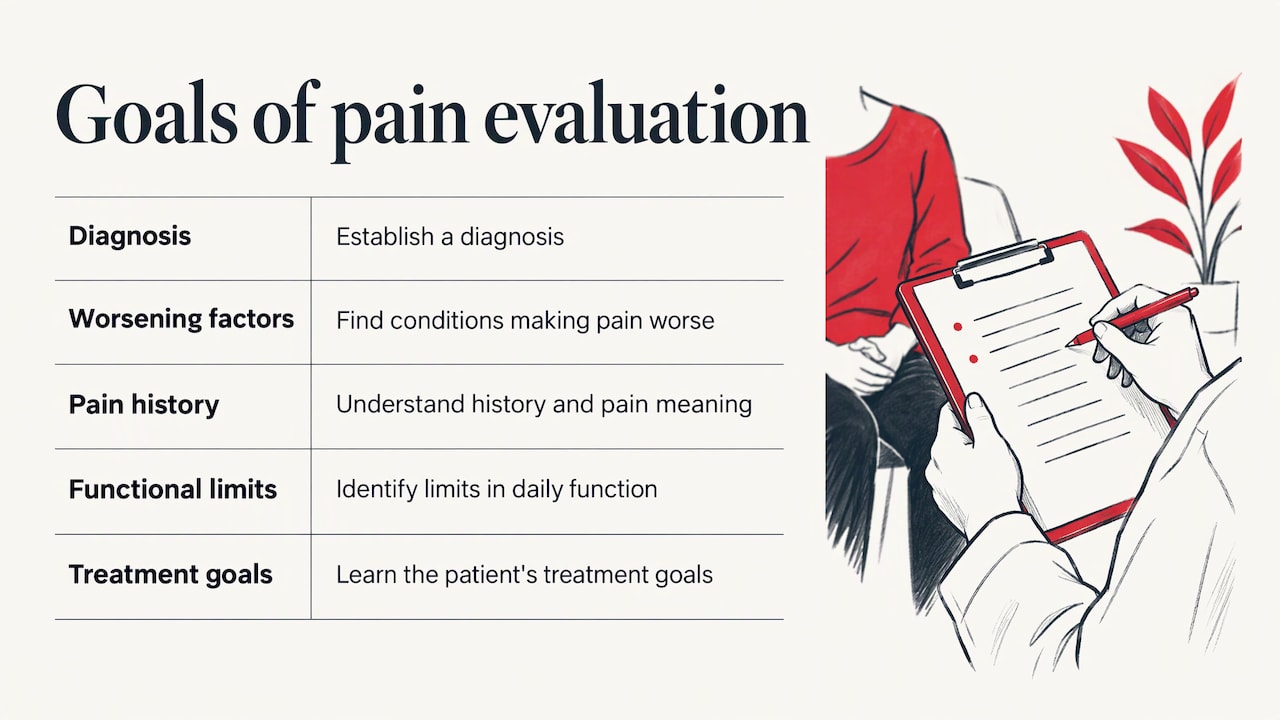
The Merck Manual says the goals of a chronic pain evaluation are to establish a diagnosis, find other conditions making the pain worse, understand your history and what the pain means to you, identify functional limits, and learn your goals for treatment.
A peer-reviewed assessment review frames it as three questions: how much disease or injury is present, how large the illness is in terms of suffering and disability, and whether your behavior fits the findings or reflects amplification from psychological or social factors. The authors argue the clinician must evaluate the whole person, because physical pathology and reported pain intensity do not line up in a simple way.
In practice, expect a visit that feels more like an interview than a lab session. That is by design.
Step 1: The history and the questions behind it
The Merck Manual describes a framework called Stanford 5. Your clinician asks about:
- Cause: what you believe is physically wrong
- Meaning: why you think you have this pain
- Goals: what you hope treatment achieves
- Treatment: what you think needs to be done
- Impact: how pain affects work, relationships, recreation and quality of life
Come prepared. Write down when the pain started, what makes it better or worse, what you have already tried, and which old records exist. The ACOEM chronic pain guideline notes that obtaining prior test results is preferable to ordering new studies, so gathering your earlier imaging and labs saves time and avoids repeat testing.
If frustration with past visits is part of your story, our guide to speaking up as a chronic pain patient covers how to get your concerns documented.
Step 2: The physical and neurological exam
The exam looks for tender areas, range-of-motion limits, weakness, sensory changes and signs of nerve involvement. For chronic low back pain, the AAFP says the exam should check for radiating nerve symptoms and for risk factors for disability. Some conditions, such as complex regional pain syndrome, are diagnosed mainly from careful clinical and neurological examination, according to a 2023 narrative review.
Step 3: Tests, and what each can show
The American Pain Society monograph groups the tests clinicians may use:
| Test type | Examples | What it can show |
|---|---|---|
| Screening labs | CBC, chemistry panel, urinalysis, ESR | General illness, inflammation, organ problems |
| Disease-specific labs | Autoantibodies | Rheumatologic or autoimmune conditions |
| Imaging | X-ray, CT, MRI, ultrasound | Structural problems, tumors |
| Nerve studies | EMG, nerve conduction | Nerve and muscle disorders |
| Nerve blocks | Diagnostic injections | Which structure is generating pain |
The International Association for the Study of Pain adds bone scans and psychological evaluation to the usual list. A California state guideline says testing is most useful when it would influence a clinical decision, such as ruling out tumor or infection.
For a closer look at nerve-related pain, see our overview of neuropathic pain testing.
Why your results can look normal while the pain is real
The assessment review above is blunt: there is no “pain thermometer,” and many people with chronic pain show no abnormality on radiographs, CT or EMG. The ACOEM guidance on low back disorders adds that MRI findings often appear in people with no symptoms, which is why results must be read against a careful clinical evaluation.
That gap is exactly why many patients feel stuck. Standard tests answer structural questions. They were not built to show how the immune system may be contributing to pain. Our article on undiagnosed chronic pain explains what to do when the usual workup comes back clean.
Adding immune markers to the picture
Immune activity is a part of pain biology that routine panels were not designed to capture. The Pain Signal Test™ looks at immune system factors linked to chronic pain through a simple blood draw. It was developed from peer-reviewed DNA research at a leading U.S. university, and it gives you objective biological information rather than guesswork.
How it fits into a workup:
- Your clinician completes the history and exam and orders any tests that could change management.
- The blood draw adds immune-marker data that standard screening labs do not provide.
- You review the results together and use them to discuss next steps.
To understand the science, read how the immune system and pain connect, what a blood test for pain can show, and what objective pain data means for your care. The test does not diagnose or treat disease on its own; results are meant to be reviewed with your healthcare provider.
Don’t forget mood, sleep and stress
The British Columbia Ministry of Health guideline recommends screening for anxiety, depression and PTSD during pain care and reassessing over time. Pain and distress feed each other, so addressing both belongs in the workup. Some readers explore therapies such as EMDR and what the research shows for the emotional side of long-term illness, alongside medical evaluation.
When more testing is called for, and when it is not
Routine imaging is not recommended for chronic low back pain unless red flags or a neuromuscular deficit are present, per the AAFP. Red flags raise concern for infection, tumor or systemic rheumatologic disease. See a clinician promptly for new weakness, numbness, bowel or bladder changes, fever, or unexplained weight loss.
The ACOEM guideline also cautions that endless testing can cause harm and can fuel a search for one lesion to be “cured.” A 2019 primary care review adds that repeated imaging is rarely helpful once appropriate investigations have been done. The better move is a targeted, objective addition that answers a question not yet asked.
Turning results into a plan
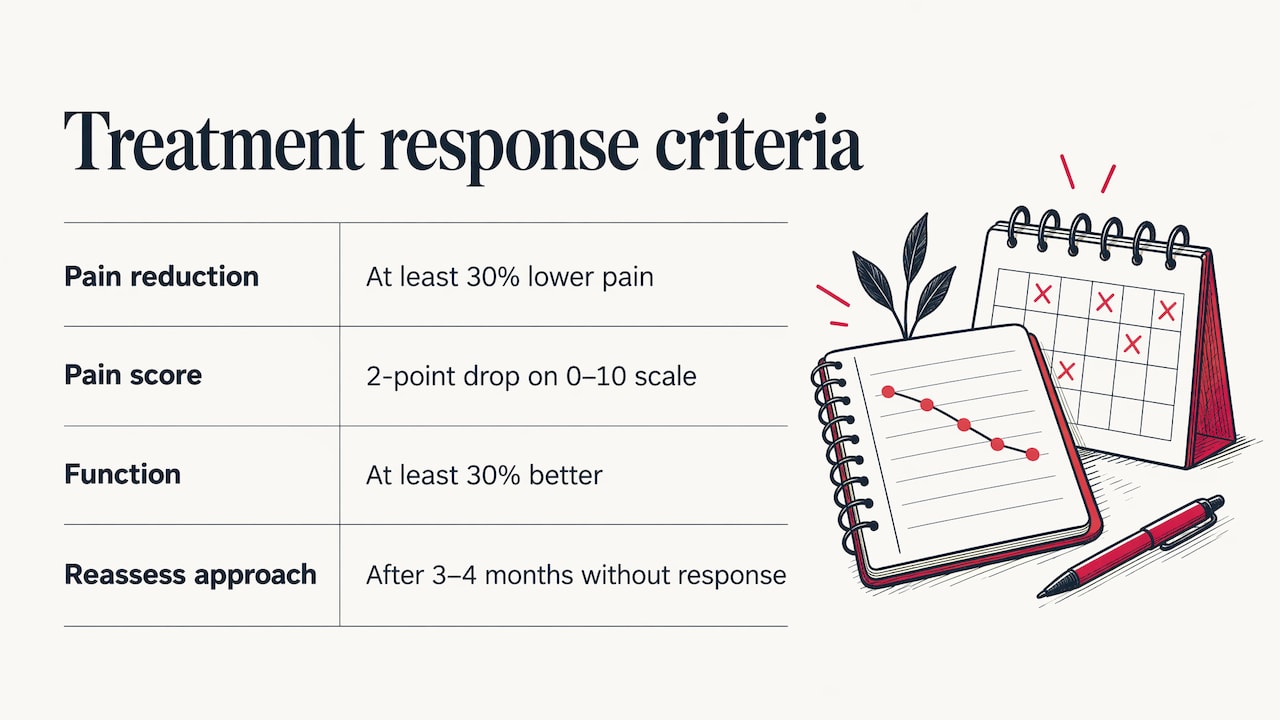
The same 2019 review says management follows risk factors, psychosocial history, pain severity and function. It defines meaningful improvement as at least a 30% drop in pain, or 2 points on a 0 to 10 scale, and or 30% better function. The BC guideline sets the goal as better function and less suffering, not necessarily zero pain, and suggests rethinking the approach if a patient who has followed therapy for 3 to 4 months is not responding.
Track your pain score and daily function before and after each change. Our guide to chronic pain treatment planning shows how to build that plan, and emerging pain treatments lists questions worth bringing to your next appointment.
Our perspective
We built our approach around one observation: chronic pain evaluation has long been strong on structure and weaker on biology. Scans show bones and discs. Routine labs screen for obvious disease. Neither was designed to show how the immune system relates to pain, and that is the piece patients often tell us has gone unexamined.
The Pain Signal Test™ comes from peer-reviewed DNA research at a leading U.S. university. We believe patients deserve objective information to bring into the room, so that the conversation with their provider starts from data and not from doubt. For providers, it is an innovative addition to the workup they already do.
Patients typically pay nothing out of pocket with Medicare or PPO coverage, and we verify coverage so cost is not the barrier.
the author
Get your immune-marker results
If your workup has left questions unanswered, The Pain Signal Test™ gives you a blood-based look at immune factors linked to chronic pain. Patients typically pay nothing out of pocket when covered by Medicare or PPO insurance, and FSA or HSA funds can also be used. You can order it directly or through your provider.

Learn about The Pain Signal Test™ and check your coverage.
FAQ
How long does a chronic pain workup take?
There is no fixed timeline. The history and exam may happen in one or two visits, while imaging, nerve studies or specialist referrals can stretch it over weeks. Gathering old records beforehand shortens the process.
Which tests are used in a chronic pain evaluation?
Clinicians choose from screening labs, imaging, nerve studies, diagnostic nerve blocks and psychological evaluation, based on your symptoms. A blood test for immune factors linked to pain, such as The Pain Signal Test™, adds biological information that these standard tests do not cover.
Can chronic pain be real if my MRI and bloodwork are normal?
Yes. Research on pain assessment shows there is no simple relationship between detectable physical findings and pain intensity, and many people with chronic pain have normal imaging. Normal results mean the cause is not visible on that test, not that the pain is imagined.
Does The Pain Signal Test™ replace my doctor’s evaluation?
No. It is one blood draw whose results are meant to be reviewed with your healthcare provider alongside your history and exam, to help guide next steps.
Sources
- Assessment of patients with chronic pain (PMC)
- Evaluation of Pain, Merck Manual Professional
- ACOEM Chronic Pain Guideline, 2017
- AAFP: Chronic Low Back Pain in Adults
- Diagnostic Criteria and Technical Evaluation of CRPS
- American Pain Society Pain Monograph
- IASP: Chronic Pain
- Pain Management Part 1 Assessment
- ACOEM Diagnostic Tests for Low Back Disorders
- Practical approach to a patient with chronic pain (PMC)