
Testing Guided Pain Care: How Test Results Shape Treatment

Testing guided pain care means using objective findings, from a clinical exam to nerve studies to blood markers, to decide what to do about persistent pain instead of trying treatments by trial and error. If you have lived with pain for months and still lack answers, a blood test that looks at immune system factors can add a missing piece. The Pain Signal Test™ is a blood draw built on peer-reviewed DNA research from a major U.S. university, and it is designed to give you and your clinician objective biological information to discuss.
TL;DR
- Good pain care starts with a full history and exam. Tests then answer specific questions, they do not replace your own report of pain.
- Exams, imaging, nerve studies and lab work each show different things, and no single test explains every kind of pain.
- Immune system markers are an often-overlooked part of chronic pain, and The Pain Signal Test™ measures them with a simple blood draw.
- Patients typically pay nothing out of pocket when covered by Medicare or PPO insurance, and coverage can be verified before you order.
- Bring your results to your clinician: they help you choose next steps together.
Table of Contents
- Why testing comes before treatment
- What a good evaluation covers first
- The tests clinicians use, and what each can show
- When each test makes sense
- When the usual results come back normal
- The case for looking at the immune system
- How results guide next steps
- Our perspective
- Getting The Pain Signal Test™
- FAQ
- Sources
Why testing comes before treatment
Pain is subjective. The American Pain Society’s monograph says a patient’s own report is the most reliable indicator of pain, and that diagnostic studies supplement a thorough history and physical exam rather than replace them. Testing guided care builds on that foundation. It does not argue with your experience. It looks for biology that helps explain it.
Why does this matter? A review in the primary care literature notes that many patients carry forward incorrect diagnoses that keep an ineffective treatment cycle going. Objective data gives you and your clinician a reason to revisit a label rather than accept it.
What a good evaluation covers first
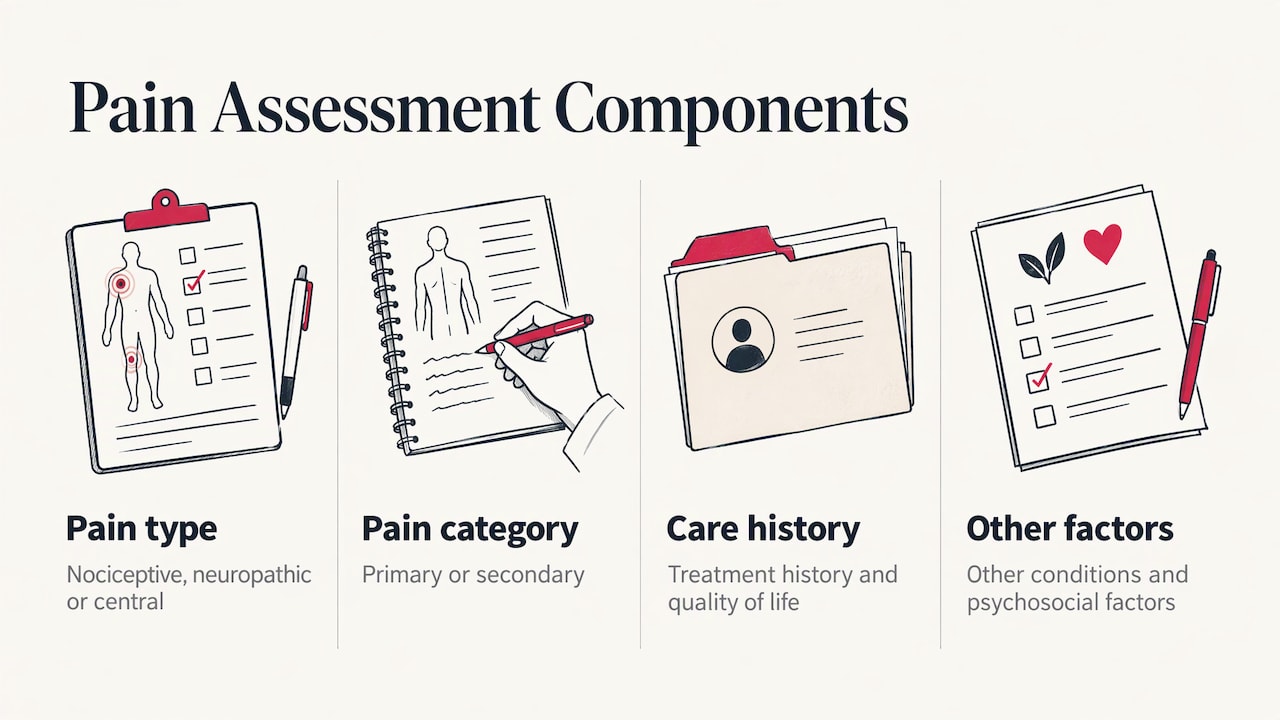
Before ordering anything, clinicians assess the whole picture. The NCBI StatPearls chapter on pain management says a chronic pain assessment should aim to identify the likely type of pain (nociceptive, neuropathic or central) and whether it is primary or secondary, along with treatment history, quality of life, other conditions and psychosocial factors.
Chronic pain is generally defined as pain lasting or recurring beyond three months. The UK’s NICE guideline NG193 separates chronic primary pain, where no underlying condition adequately accounts for it, from chronic secondary pain. That distinction is useful anywhere: when scans and standard labs come back clean, the pain is still real, and the search for contributing factors continues.
You can make the visit more productive. The National Institutes of Health suggests describing how long you have had the pain, where it is, how it feels, what makes it better or worse, and keeping a pain diary. Our guide to what a pain management assessment covers walks through the preparation, and the chronic pain workup overview explains what to expect.
The tests clinicians use, and what each can show
The NIH lists the main categories of pain diagnostics. Each answers a different question.
| Test type | What it can show |
|---|---|
| Physical and neurological exam | Reflexes, sensation, strength, balance, signs of inflammation or nerve involvement |
| Imaging (MRI, CT, X-ray, ultrasound) | Structural problems in bones, joints, discs and soft tissue |
| Nerve conduction studies and EMG | Whether nerves and muscles are conducting signals normally |
| Skin biopsy or quantitative sensory testing | Suspected small nerve fiber damage |
| Laboratory tests | Infection, nutritional or hormonal problems, autoimmune and metabolic conditions |
| Psychological and functional assessment | Sleep, mood, coping, and effects on daily life |
Source for the categories: NIH pain overview. The National Institute of Neurological Disorders and Stroke adds that research is ongoing to find biological markers that help explain why a person has pain. That is the space a blood-based immune marker test occupies.
For nerve-related pain in particular, see our breakdown of neuropathic pain testing: exams, nerve studies and blood tests.
When each test makes sense
More testing is not always better. The VA/DoD low back pain guideline recommends against routine imaging for acute low back pain, and notes that advanced imaging often shows abnormalities in people with no symptoms, which can set off unnecessary follow-up. It recommends imaging and lab work when there are serious or progressing neurologic deficits or red flags.
A practical way to think about it:
- New, severe or worsening symptoms. Numbness, new weakness, severe rapidly worsening pain, or pain after a fall or injury call for prompt medical care, according to the NIH.
- Suspected nerve pain. Screening questionnaires, nerve studies and, for suspected small fiber neuropathy, skin biopsy. A 2023 European guideline gives strong recommendations for skin biopsy and for the DN4 and LANSS questionnaires.
- Pain that persists without a clear structural cause. Here the question shifts from what is damaged to what is driving the pain signal. Immune and inflammatory factors belong in that conversation.
When the usual results come back normal
This is where many people get stuck. A peer-reviewed assessment review reports that significant numbers of chronic pain patients show no abnormality on plain radiographs, CT or electromyography, and that reported pain severity is only modestly linked to objective findings.
Normal results do not mean nothing is wrong. The American Pain Society states that pain can exist when no physical cause is found and should not be routinely blamed on psychological causes. NICE likewise asks clinicians to avoid invalidating a person’s experience when sharing normal results.
If this is your situation, our article on undiagnosed chronic pain and what to do next is a good next read. For a broader look at how people with hard-to-explain pain have been approached, the Pain Signal Test™ immune-system approach is built around a factor that standard imaging cannot see.
The case for looking at the immune system
Research interest in biological markers of pain is growing. A 2025 review in Diagnostics argues that combining standardized clinical criteria with validated biomarker panels, including inflammatory mediators, could shorten diagnostic delay and support individualized treatment in complex regional pain syndrome. The direction is clear: pain care is moving toward objective biological data alongside the exam and your own report.
We cover the research behind this in objective pain data: what it is and what it can show and what the largest genetic study of chronic pain found. If you are wondering how this differs from genetic testing, read DNA testing for chronic pain.
How results guide next steps
Results matter only if they change decisions. A useful result helps your clinician narrow the likely type of pain, which in turn guides treatment strategy, as the NCBI chapter describes. It also gives you a concrete starting point for a conversation, which is especially valuable if past treatments have not worked.
Good care also includes follow-up. The ACOEM chronic pain guideline suggests visits every one to two weeks at first for patients seeing a new clinician, focused on function and confirming the diagnosis. Build your plan around those check-ins, and see chronic pain treatment planning and emerging pain treatments and what to ask for what to raise with your care team.
Some people explore complementary options while they build a plan. One example you may see discussed is hyperbaric chamber use in fibromyalgia; talk with your clinician about anything you add.
Our perspective
Chronic pain care has relied on guesswork for too long. Patients are told their scans are clean, then handed one treatment after another. We built The Pain Signal Test™ because the immune system’s role in pain is often overlooked, and because a patient deserves objective biological information, not just a shrug.
Our test starts from peer-reviewed DNA research at a leading U.S. university and uses a simple blood draw. We designed it to support your conversation with your healthcare provider, so that next steps rest on data you can both see.
We also want cost to stop being the barrier. Patients typically pay nothing out of pocket when covered by Medicare or PPO insurance, and we verify coverage.
the author
Getting The Pain Signal Test™
The Pain Signal Test™ measures immune system markers linked to chronic pain from a single blood draw. You can order it directly or through your healthcare provider. Payment can come through Medicare or PPO coverage, out of pocket, or with FSA or HSA funds. See how The Pain Signal Test™ works and verify your coverage.

FAQ
Does testing guided pain care replace a doctor’s evaluation?
No. It adds to it. Your history, exam and own description of pain remain the foundation, and test results help your clinician interpret them. Share any result with the provider who manages your care.
Can a blood test explain chronic pain?
Blood work can look at several things, including immune and inflammatory factors. The Pain Signal Test™ measures immune system markers linked to chronic pain, giving you objective information to review with your clinician.
Will insurance cover the test?
Patients typically pay nothing out of pocket if covered by Medicare or PPO insurance. Coverage can be verified, and FSA or HSA funds are another way to pay.
What should I bring to my appointment?
Bring a pain diary with location, timing, triggers and a 0 to 10 severity rating, plus your treatment history and any prior results. The NIH recommends this kind of clear pain description and diary.
Sources
- American Pain Society, Pain Monograph
- Gebke et al., practical guide to recognize, assess and treat chronic pain
- NCBI Bookshelf, Pain Management
- NICE NG193, Chronic pain recommendations
- NIH, Pain
- NINDS, Pain
- VA/DoD low back pain guideline
- EAN, EFNS and IASP neuropathic pain guidelines, 2023
- Assessment of patients with chronic pain, PMC
- Fooladi et al., Diagnostics, 2025
- ACOEM Chronic Pain guideline